
In Good Company: Costa Rica's Artists and Our New Art Workshop
Article by Ryan
Something good is happening at Ceiba Rancho every Tuesday at 3pm. Our new weekly art workshop has filled the tables with watercolors, pencils, and kids who don't want to go home. The parents who came along to watch? Most of them have a brush in hand as well!
There's a special kind of freedom in making something with no rules and no grade. For a lot of us grown-ups, it's been years. Watching a room of neighbors freely create art has been one of the nicest sights in the village lately.
As the workshop finds its feet, it seemed like a good moment to meet some of the Costa Rican artists who came before us. Their stories have a lot in common with what's happening at our tables: ordinary people, local materials, and a deep love for this land.
Where it started
In 1897, a Spanish painter named Tomás Povedano took charge of Costa Rica's new national fine arts school [1]. He taught drawing and oil painting the European way, introduced watercolor to the country, and loved painting native orchids. Three of his large oils still decorate the Teatro Nacional in San José.
Povedano's students learned the rules well. The next generation decided to break a few.
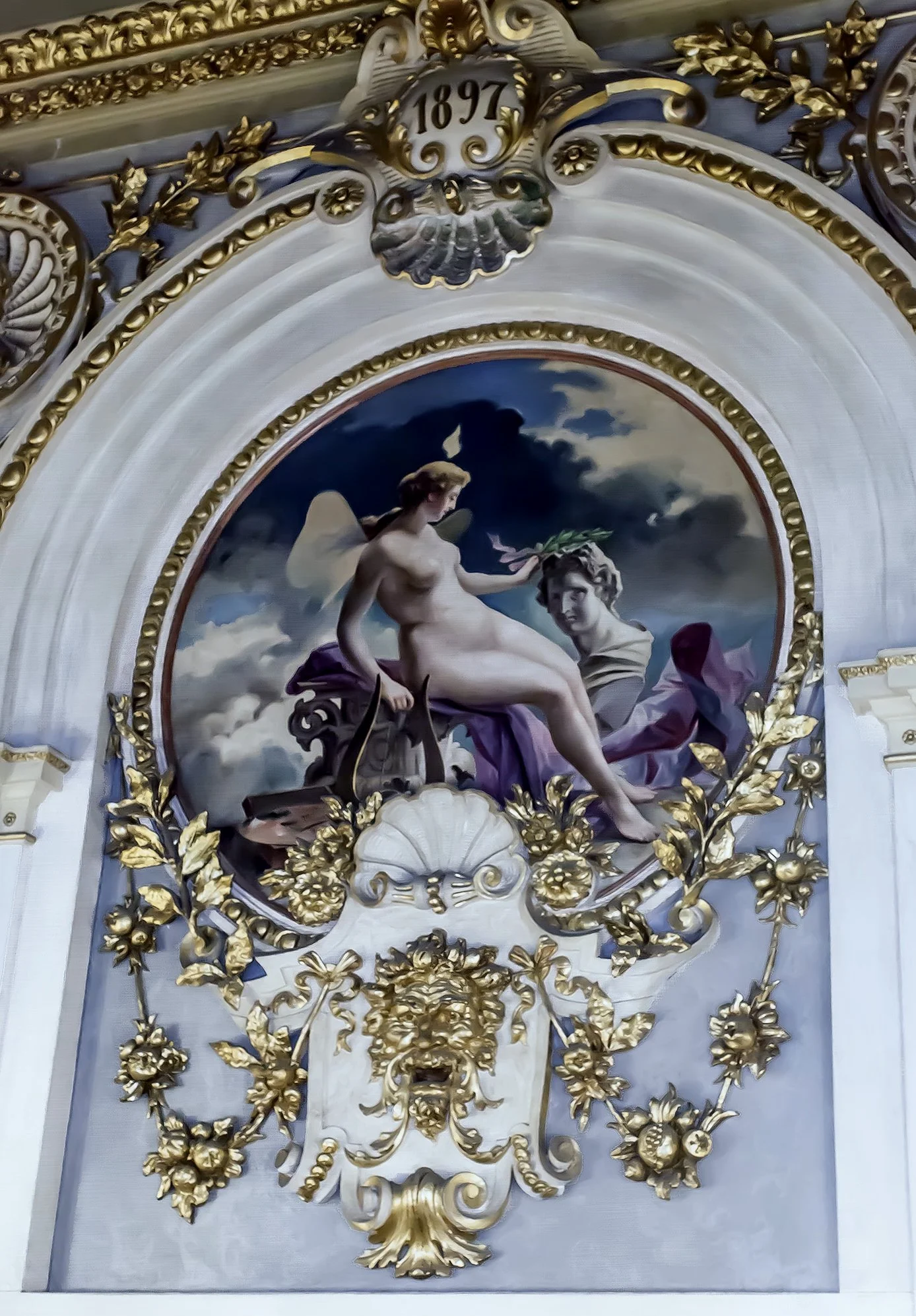
Tomás Povedano, El arte, allegorical painting at the Teatro Nacional de Costa Rica, late 19th century.
Painting the campo
Around 1930, a group of young Costa Rican artists turned away from European models and started painting what they saw at home [2]. Farmers and oxcarts. Adobe houses and coffee hills. Market days and Indigenous motifs. People came to call them the Nueva Sensibilidad, or the Nationalist Generation.
Francisco Amighetti was one of the brightest. He painted, wrote poetry, and became the country's leading master of the color woodcut, carving images into wood blocks and printing them [3]. In 1934 he and his friends published the first album of prints in Costa Rican history [4].
Teodorico Quirós, a painter and architect, helped organize the exhibitions that gave this generation a stage. He later pushed the government to protect humble adobe buildings, not just grand colonial ones [5]. That should please anyone who loves natural building.
A mural with two stories
Margarita Bertheau was part of the first wave of Costa Rican women artists, and a dancer and set designer too [6]. With Amighetti, she worked on a large mural called La Agricultura (1948). At first glance it's a peaceful farming scene. Look closer and, in the distance, someone is being shot [7].
It's a reminder that art can hold beauty and hard truths at the same time.
Shaking things up
By the 1960s, a new crew called Grupo Ocho was ready for something different. Their first show, in 1961 near the Teatro Nacional, brought abstract art to a public that wasn't quite sure what to make of it [8].
Lola Fernández, the group's only woman, had held one of the country's first abstract exhibitions in 1958 [9]. She had studied under Amighetti. Along with Bertheau and two others, she taught at the University of Costa Rica, and the four are credited with inspiring the next generation of women artists [10].
Tico artists on the world stage
Francisco Zúñiga learned sculpture as a boy, carving church figures in his father's San José workshop. He moved to Mexico in 1936 and became famous for monumental, dignified figures of Indigenous and mestiza women [11].
Jorge Jiménez Deredia, born in Heredia in 1954, found his inspiration in Costa Rica's mysterious pre-Columbian stone spheres. In 2000 he became the first Latin American sculptor to place a work in St. Peter's Basilica at the Vatican [12].
Then there's Isidro Con Wong, born in Puntarenas to Chinese parents. He spent years farming, fishing, and raising cattle around the Gulf of Nicoya before his dreamlike paintings of bulls, volcanoes, and Pacific light won an international prize in Monte Carlo [13]. He kept working in his studio into his nineties and passed away in 2024 at 93. If you ever feel it's too late to start, remember don Isidro.
Art you already know
Some of Costa Rica's best-loved art isn't in a museum at all. The painted oxcarts of Sarchí, with their bright wheels of stars and flowers, began as decorated farm carts, and regions developed their own designs [14]. UNESCO proclaimed the country's oxherding and oxcart traditions part of the world's intangible cultural heritage in 2005 [15].
In the south, Boruca artisans carve masks from balsa and cedar for the Juego de los Diablitos, held each year from December 30 to January 2 [16]. The masked "little devils" represent the Boruca people, and they always defeat the bull that stands for the Spanish conquerors.
Bringing it to our tables
These artists give our workshop plenty of ideas to borrow. Kids could design their own oxcart wheel patterns on paper plates. A foam or potato stamp is a gentle first step toward Amighetti's woodcuts.
Cardboard and paint can become a Boruca-style mask. And a walk to collect round stones might start a conversation about Deredia's spheres.
If you'd like to see the real thing, the Museo de Arte Costarricense in La Sabana holds the country's largest collection of Costa Rican art, with a sculpture garden out back [17]. Sarchí makes a fine family day trip too.
Join in
The workshop meets [day and time] at [location]. [Insert who leads it and what to bring, if anything.] Everyone is welcome, whatever your age and however long it's been since you last picked up a crayon.
Pick up a brush. You're in good company.
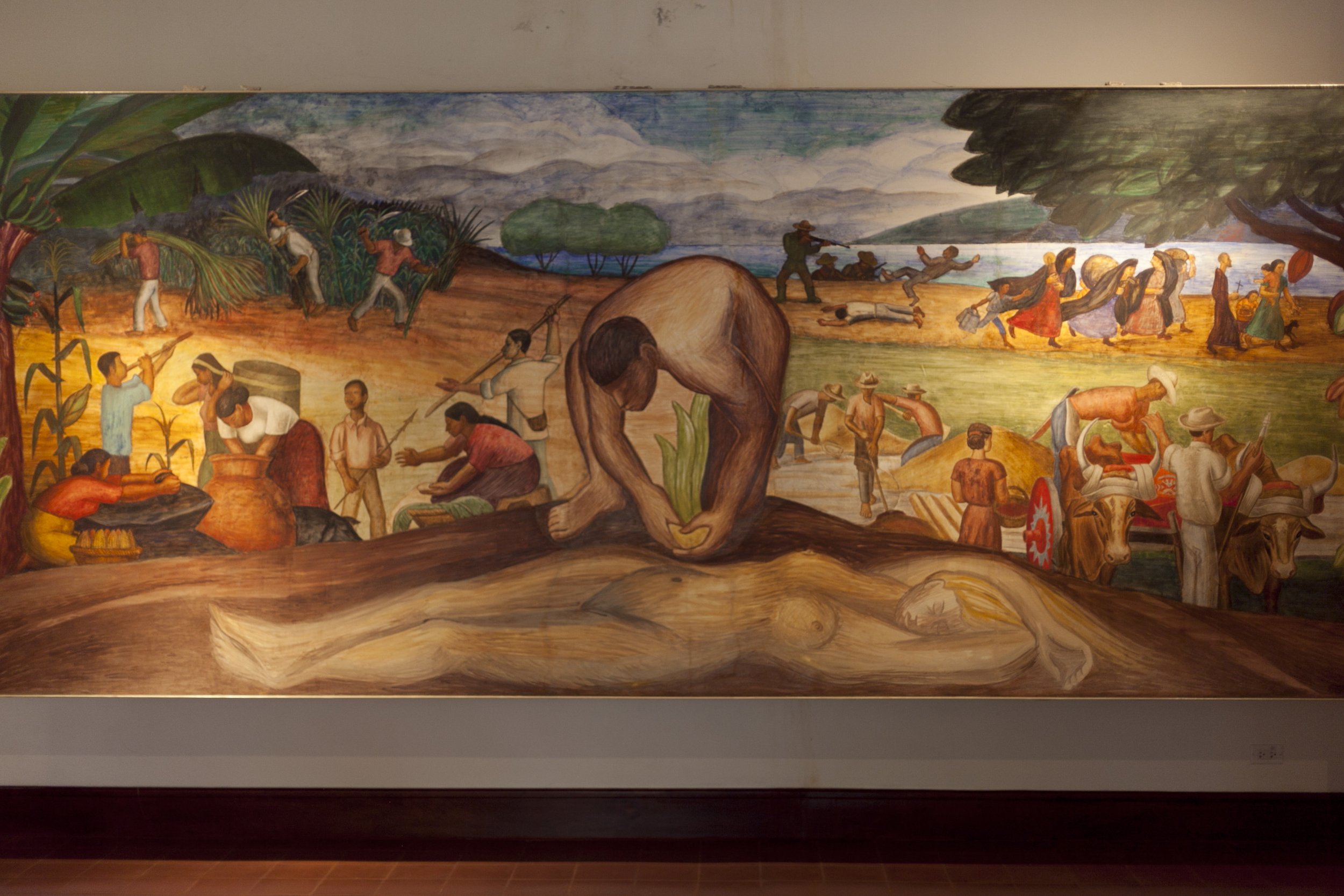
Francisco Amighetti, La Agricultura (1948), mural. Photo: Mark DeVries, CC BY-SA 2.0
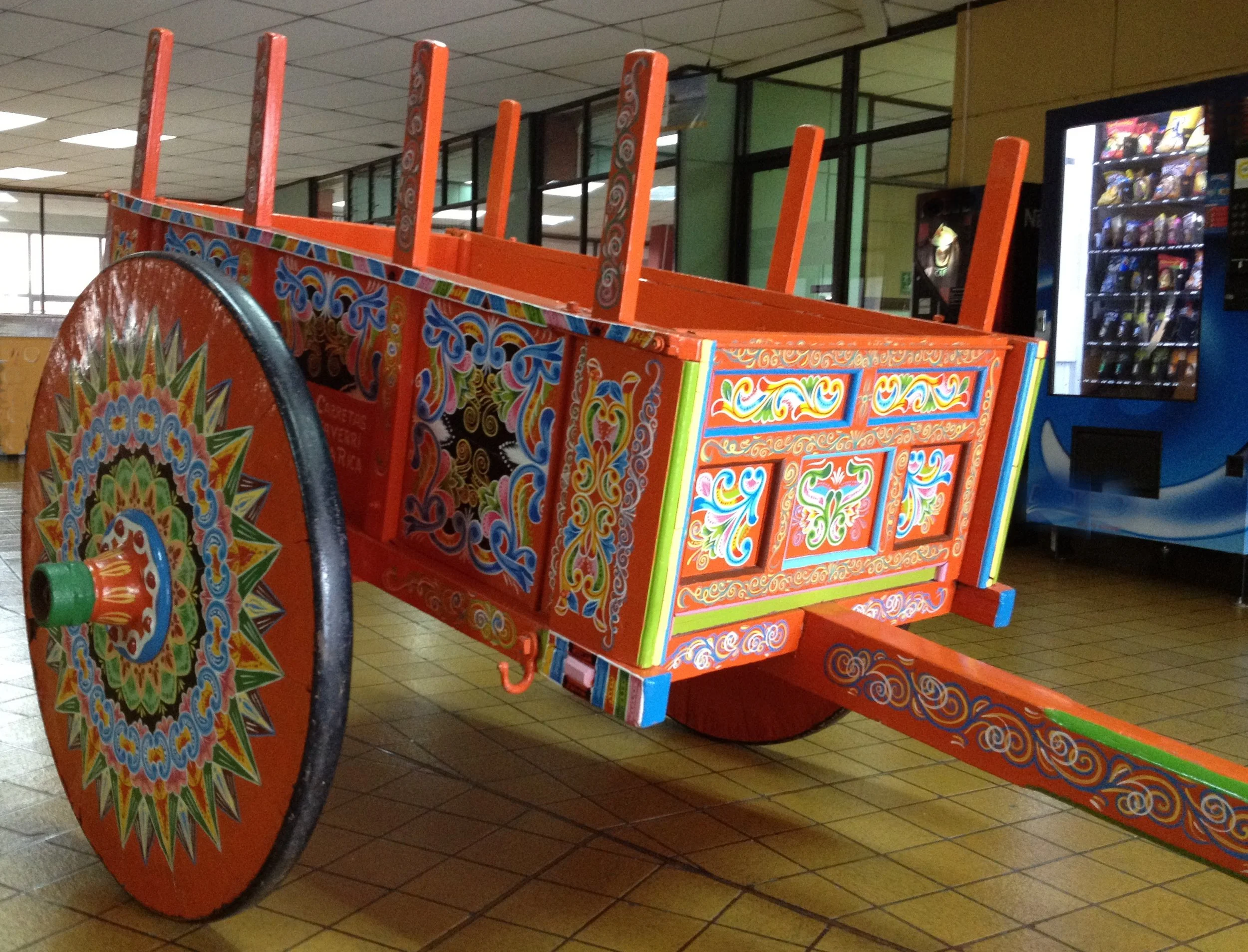
Traditional Sarchí oxcart, made around 1950 by Talleres Chaverri for everyday work. Photo: Axxis10, CC BY-SA 3.0
Notes
Tomás Povedano: https://en.wikipedia.org/wiki/Tom%C3%A1s_Povedano and https://www.donquijote.org/costarican-culture/art/painters/
Pintura de Costa Rica (Nueva Sensibilidad): https://es.wikipedia.org/wiki/Pintura_de_Costa_Rica
Francisco Amighetti, biography: https://www.invaluable.com/artist/amighetti-francisco-kppuvrd7jf/sold-at-auction-prices/
The Costa Rica News, "Francisco Amighetti": https://thecostaricanews.com/francisco-amighetti-a-multifaceted-artist-and-benemerito-de-la-patria/
Teodorico Quirós: https://en.wikipedia.org/wiki/Teodorico_Quir%C3%B3s
Margarita Bertheau: https://en.wikipedia.org/wiki/Margarita_Bertheau
Francisco Amighetti: https://en.wikipedia.org/wiki/Francisco_Amighetti
Las Vanguardias en Costa Rica (Grupo Ocho): https://wi11iamv3ntura.wixsite.com/historiadelarte/las-vanguardias-en-costa-rica
OAS Art Museum of the Americas, Lola Fernández: https://www.oas.org/artsoftheamericas/lola-fernandez
Dinorah Bolandi (first wave of women artists): https://en.wikipedia.org/wiki/Dinorah_Bolandi
Academia de Artes (México), Francisco Zúñiga: https://academiadeartes.org.mx/en/miembros/zuniga-francisco/
Sist'Art Gallery, Jiménez Deredia: https://sistart.org/artists/jorge-jimenez-deredia/
La Nación, "Murió Isidro Con Wong": https://www.nacion.com/viva/cultura/murio-isidro-con-wong-destacado-artista-plastico-a/E6CZEGNHUREUFOIZPXLTQHDGDI/story/
Tico Times, oxcart painting: https://ticotimes.net/2026/08/06/forbes-costa-rica-oxcart-painting-experience
UNESCO, Oxherding and oxcart traditions in Costa Rica: https://ich.unesco.org/en/RL/oxherding-and-oxcart-traditions-in-costa-rica-00103
Juego de los diablitos de Boruca: https://es.wikipedia.org/wiki/Juego_de_los_diablitos_de_Boruca
Frommer's, Museo de Arte Costarricense: https://www.frommers.com/destinations/san-jose-costa-rica/attractions/museo-de-arte-costarricense-costa-rican-art-museum/