
By Staff Writer Claudia
Life at Ecovilla San Mateo brings plenty of new vocabulary. Somewhere between pura vida, construction estimates, and residency paperwork, another term appears: Hacienda, Costa Rica’s Ministry of Finance.
Taxes can sound intimidating, especially when information arrives through neighborhood conversations or social media. Yet the basic picture is quite approachable. For families settling into ESM, it helps to look at a few everyday situations: receiving retirement income, owning a home, renting a casita, or earning money through a business.
Where the income comes from matters
Costa Rica generally follows a territorial tax system. In everyday language, that means its income taxes focus mainly on income generated in Costa Rica. Foreign-source income generally falls outside that system, with specific exceptions, including rules for certain multinational business entities.
For someone living here on a foreign pension, this can be an attractive feature. A pension earned through a career abroad generally falls outside Costa Rican income tax. Foreign investments can also receive favorable treatment when the income is genuinely foreign-source. The important detail is how the income arises, not simply the country where the bank account sits.
Working online adds another layer. A client abroad or payment into an overseas account does not automatically make earnings foreign-source when the work takes place in Costa Rica. The approved digital nomad program provides a specific income-tax exemption for qualifying foreign remote-work income.
A home comes with a fairly simple starting calculation
Costa Rica’s basic municipal property tax is 0.25% annually of the property’s registered taxable value. That is one-quarter of one percent, or $250 per year for every $100,000 of taxable value. The figure used for taxation can differ from a listing price or someone’s estimate of market value.
Here is what that looks like:
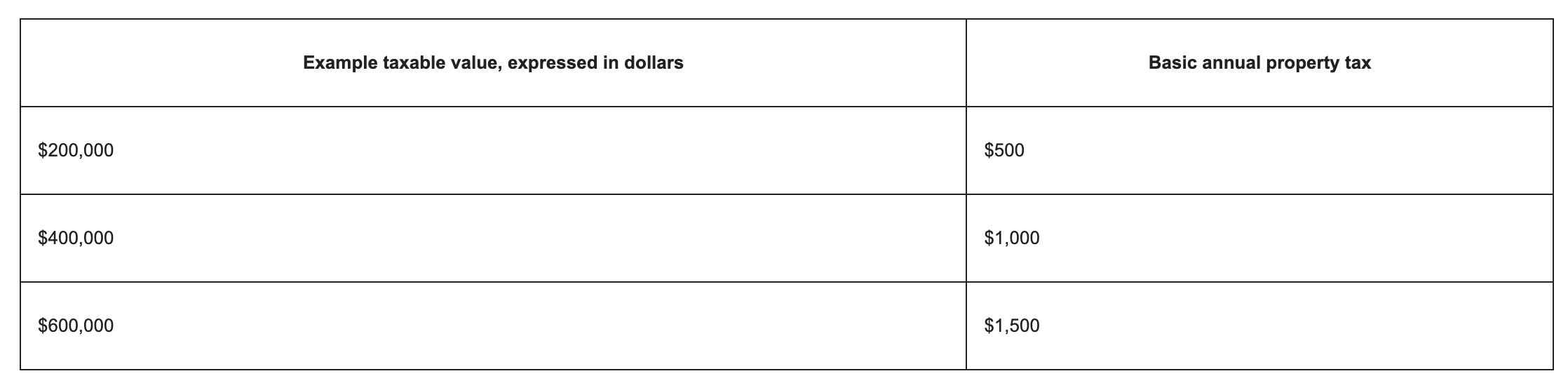
These are illustrations of the basic calculation, before any applicable exemption or additional charge. Some homes also fall within a separate national solidarity tax, commonly called the luxury-home tax. For 2026, the qualifying threshold concerns construction and fixed installations valued above ₡143 million. This is a separate calculation from ordinary municipal property tax, so a home’s sale price alone does not establish the result.
What about renting out a casita?
A rental casita creates income connected to property in Costa Rica. That puts it in a different category from a pension earned overseas, even when the guests pay from another country.
Under the rental-capital-income system, the standard calculation allows a 15% deduction from gross rental income and applies a 15% tax to the remaining amount. For a rental that belongs in that system, this works out to 12.75% of gross rent. For example, $1,000 in rent produces an income-tax calculation of $127.50.
That example describes one tax treatment. A rental operated as a business can fall under a different income-tax approach, and VAT has its own rules. Residential leases and visitor accommodation do not automatically receive identical treatment. For an ESM family planning a rental, an accountant can explain which category fits the actual arrangement.
Small-business tax: sales and profit do different jobs
I’ve seen social media claims that small companies pay between 5% and 20%, which is based on Costa Rica’s tax structure. The useful distinction is that sales determine eligibility for the smaller-company brackets, while taxable profit determines the income-tax calculation.
For 2026, qualifying companies with annual gross income no higher than ₡119,174,000 use progressive profit-tax brackets of 5%, 10%, 15%, and 20%. The legal threshold is expressed in colones, so a dollar description such as “about $250,000” is only an approximation. Companies outside the reduced-rate category generally face a 30% profit-tax rate.
Imagine a small company collecting $40,000 from customers and spending $25,000 on allowable business expenses. Its starting profit is $15,000. The income-tax calculation focuses on taxable profit after the relevant adjustments, rather than treating every dollar collected as profit.
A person working independently has a different set of brackets from a company. That makes the choice of business structure part of the conversation: the same small enterprise can have different paperwork and tax calculations depending on how it operates.
IVA is the tax people encounter most often
IVA is Costa Rica’s value-added tax. Its general rate is 13%, although exemptions and reduced rates apply to particular goods and services. It appears in everyday purchases and service bills, including many costs connected with setting up a home.
IVA and income tax answer different questions. IVA concerns a sale or service; income tax concerns taxable income or profit. Seeing IVA on an invoice does not mean that it also covers the seller’s income tax.
A quick note for American families
Costa Rica’s treatment of income is one part of an American household’s tax picture. The United States generally taxes citizens and resident aliens on worldwide income, with filing requirements depending on income and other circumstances. Living abroad can also bring access to particular exclusions or credits.
That means income outside Costa Rican income tax can still matter on a U.S. return. A professional familiar with both countries can connect those pieces and explain which provisions apply to a particular family.
What about the proposed tax on foreign income?
The slides also mention a possible change. Bill 25,796 proposes expanding taxation of certain foreign-source passive income, including interest, dividends, rents, royalties, and capital gains, to a broader group of Costa Rican tax residents. Its text concerns particular income categories rather than a blanket tax on every payment arriving from abroad.
As of October 20, 2026, the legislative tracker lists the proposal in committee. Its eventual wording, progress, and effective date remain matters to follow. The proposal itself does not establish a new tax bill for residents today.
A little clarity goes a long way
For families at ESM, a useful starting point is a simple description of their own situation: where their income originates, how they own their home, and whether they earn anything locally. Those details make a conversation with an accountant much more concrete.
A household receiving a foreign pension, a family renting a guest casita, and a neighbor running a local business have different questions. Understanding those differences makes the subject easier to navigate, and leaves more room for enjoying the life everyone came here to build.
This article is general information for community readers. Individual tax treatment depends on the income, ownership structure, and circumstances involved.