
By Staff Writer Claudia
Research checked October 20, 2026. All amounts are in U.S. dollars. This guide provides general information; confirm the current requirements for your nationality and family before applying.
Moving to Ecovilla San Mateo involves more than arranging a shipment or finishing a house. Families also need to decide how each person will legally remain in Costa Rica, whether their status permits their intended work, and what happens when their initial passport stamp expires. Those questions become especially important when school calendars and construction schedules stretch beyond the original moving plan.
People often use “visa” to describe every immigration option, but Costa Rica distinguishes tourist admission, temporary residence, permanent residence, and special stays such as the digital nomad program. Buying an ESM lot does not automatically grant residency. The right choice depends on your income, investments, family relationships, and plans for working here.
The main options at a glance
The financial requirements below establish eligibility. They are separate from application fees, legal fees, insurance, and living expenses.
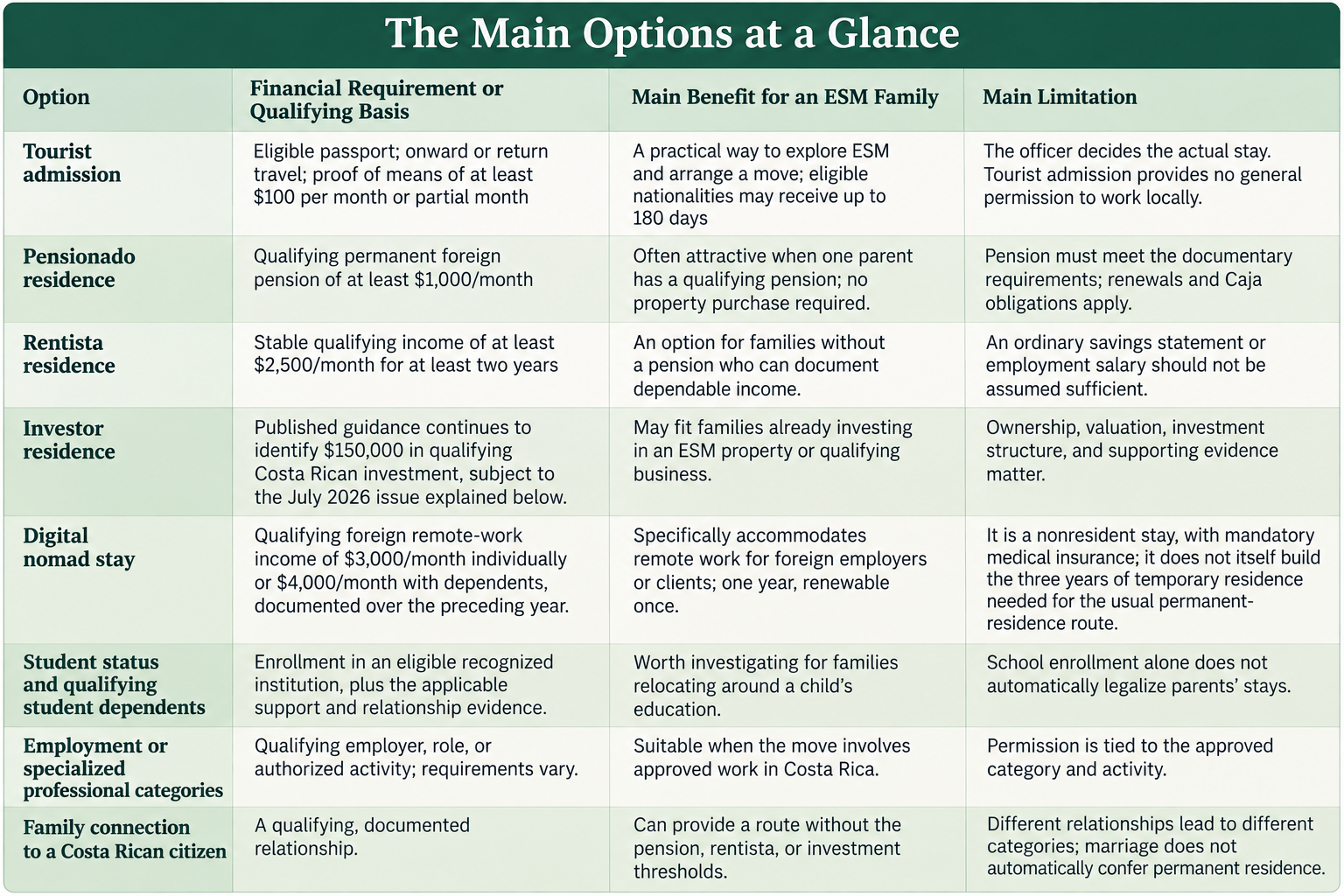
What can families do with a 180-day passport stamp?
Citizens of countries in Costa Rica’s first entry group, including the United States, may receive up to 180 calendar days. This is a maximum, not a guaranteed allowance. Check every family member’s admission record (passport), keep proof of onward travel, and use the actual authorized period when planning departures. A full 180-day tourist stay is nonextendable under the published entry guidance. (embassycr.org, visitcostarica.com)
For ESM families, tourist admission can provide time to rent, experience the community, oversee arrangements for a home, and prepare a residency application. It does not automatically become residence because a family buys property or enrolls a child in school. Families planning paid work should establish which immigration category authorizes that activity rather than assume tourist admission covers it.
Leaving and returning involves a new admission decision. Another 180 days should never be treated as guaranteed. Even where repeated visits have worked previously, organizing a permanent family home around repeated border trips creates uncertainty.
Pensionado: potentially the simplest route for a qualifying pension recipient
Pensionado residence requires a qualifying permanent foreign pension of at least $1,000 per month. The decisive issue is the pension and its documentation, rather than whether the applicant has reached a particular conventional retirement age. A family with a military, government, Social Security, or private pension should obtain confirmation that its specific award meets the requirements.
This route can be particularly useful when a family qualifies through a pension while also owning property at ESM. There is no need to select investor residence solely because the family purchased a home. Eligible dependents can apply through the principal applicant’s qualification, subject to their own documents and applications. (icoder.go.cr, expatpropertiescr.com)
Rentista: dependable income, rather than a qualifying pension
Rentista applicants must demonstrate at least $2,500 in stable monthly income for a minimum of two years. The regulations describe bank evidence and, in appropriate circumstances, certification by a Costa Rican certified public accountant supported by reliable documents. Families should have their proposed income evidence reviewed before arranging transfers or committing funds. (pgrweb.go.cr)
A frequently discussed approach involves $60,000, representing $2,500 multiplied by 24 months. That arithmetic does not make any account containing $60,000 automatically acceptable. The bank arrangement and certification must establish the required income, and families should understand what must be maintained or demonstrated at renewal.
Investor residence: especially relevant to ESM property owners
Investor residence may suit a family whose qualifying Costa Rican investment meets the required threshold. Published guidance continues to identify $150,000, but the purchase price alone does not settle eligibility. For an ESM purchase, the important questions include whose name holds the investment, the officially supportable value, any financing, and how land and construction payments are documented. (ict.go.cr, crie.cr)
Before relying on this route, have the proposed ownership structure reviewed. Property held through a company, jointly owned property, unfinished construction, and deposits toward future work deserve particular attention. A purchase contract or developer’s assurance should not substitute for a review of the evidence Immigration will require.
There is also a significant 2026 distinction. Law 9996 established both the reduced investment figure and separate tax incentives. Article 12 limited the opportunity to opt into Article 5’s incentives to the first five years after publication in July 2021; qualifying beneficiaries retain benefits for ten years from their grant. New arrivals should therefore not budget on receiving tax-free household goods or vehicle imports merely because they obtain residency. (pgrweb.go.cr)
Online explanations disagree about whether the investment minimum also changed after July 2026. Current published guidance reviewed for this article continues to report $150,000, while some advisers interpret the law’s timing differently. For a new ESM investment application, obtain written confirmation of the applicable threshold and evidence before committing money specifically to qualify. (crie.cr)
Digital nomad status: useful for overseas work
For a parent working remotely for an employer or clients outside Costa Rica, the digital nomad program offers a category expressly designed for that arrangement. Applicants must document qualifying income over the previous year. The family threshold is $4,000 per month, rather than $4,000 for every family member. (visitcostarica.com)
The program provides a one-year stay with a possible second year. Renewal requires, among other conditions, at least 80 days’ presence in Costa Rica during the authorized period. Each family member must have qualifying medical coverage, including at least $50,000 in medical-expense protection for the authorized stay. (visitcostarica.com, visitcostarica.com)
This can work well for a family trying life at ESM or planning a shorter stay. Families intending to settle permanently should compare it with residence categories, because digital nomad status is legally a nonresident estancia.
Does one family member’s approval cover everyone?
One person can often provide the qualifying basis, but approval does not automatically extend to the whole family. Each eligible dependent needs an application, identity documents, relationship evidence, and applicable payments.
For pensionado and rentista applicants, the law allows the qualifying amount to support applications for a spouse and children under 25, with provisions for older children with disabilities. Investor residence also accommodates qualifying dependents. Adult children, blended families, custody arrangements, and unmarried partners should be reviewed individually. (icoder.go.cr, migratoria-la.com)
The digital nomad program expressly recognizes spouses or qualifying common-law partners, eligible children, and certain older adults living with the principal applicant. Its relationship-document requirements differ from the residence categories. Families should choose the route first, then obtain the correct documents for that route. (visitcostarica.com)
What does applying actually cost?
A pension requirement is income to prove, and a qualifying investment is an asset commitment. Neither is an application fee. Budget separately for the following:
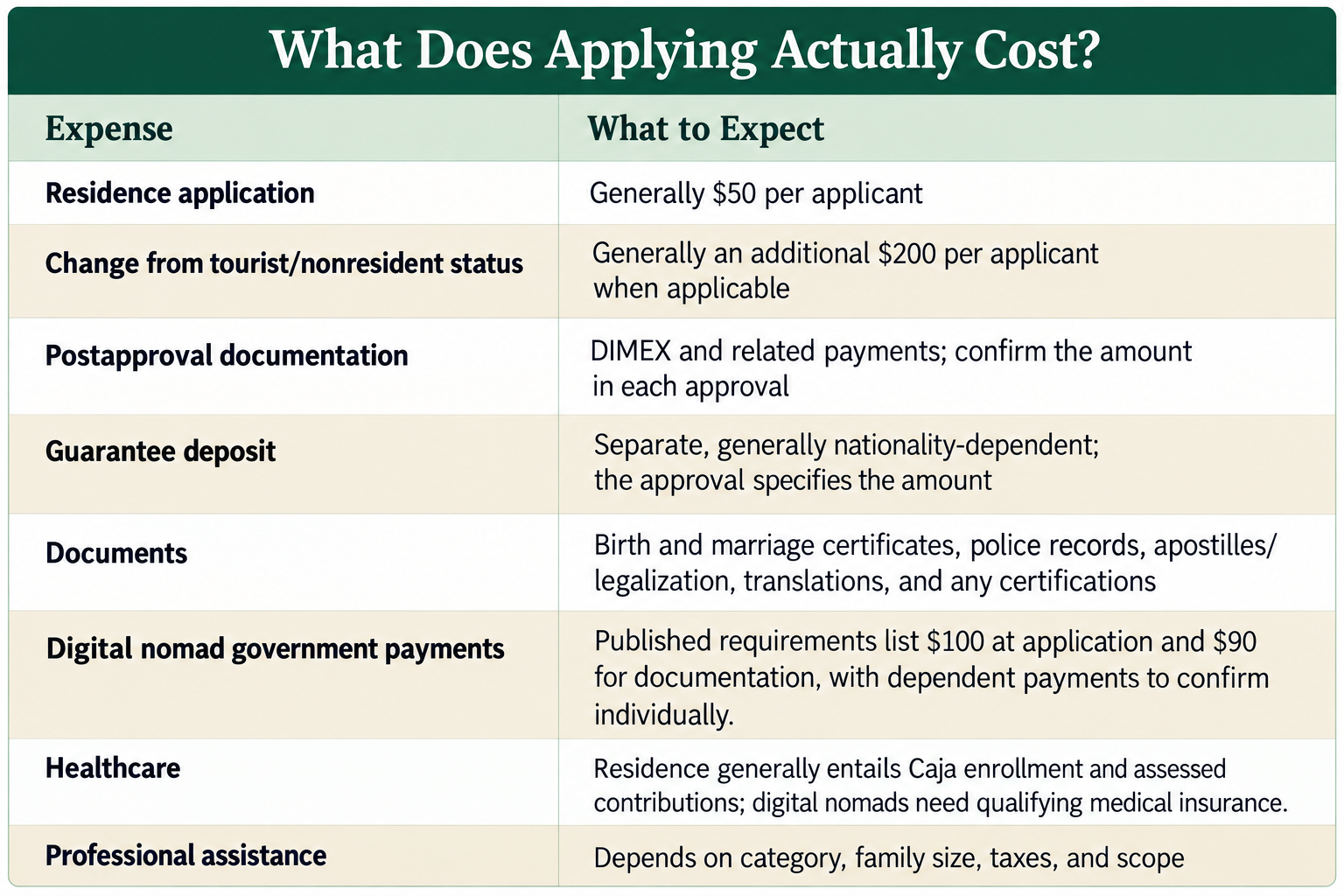
The $250 commonly quoted for residence filing is therefore a starting payment, not the full cost of obtaining residence. (crie.cr, icoder.go.cr, visitcostarica.com, visitcostarica.com)
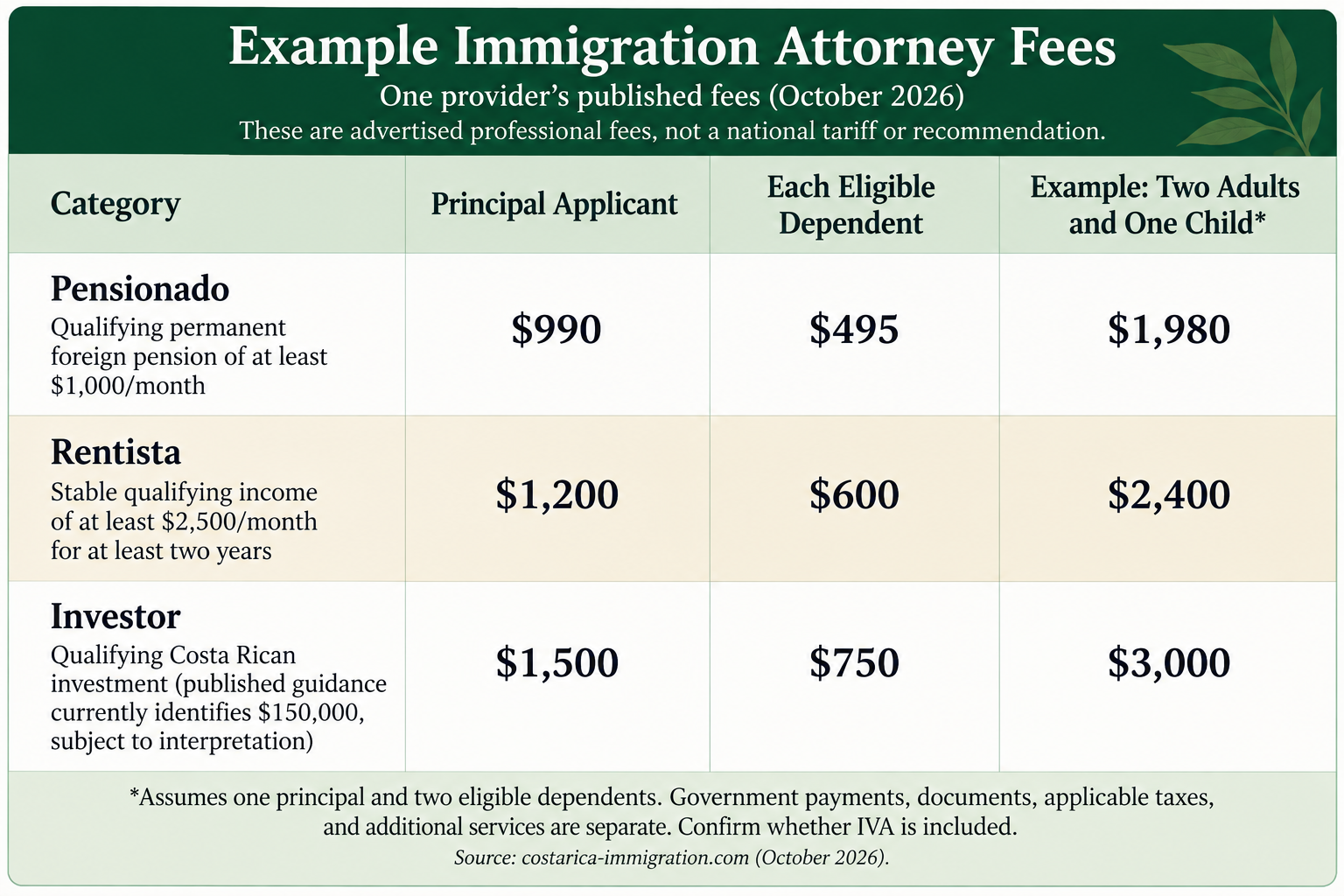
For a concrete legal-fee illustration, one provider’s October 2026 published schedule lists the following. These are one provider’s advertised professional fees, not a national tariff or recommendation:
Apply yourself or hire an attorney?
Applying independently can be reasonable for an organized family with a straightforward case, sufficient Spanish, and time to manage documents, payments, notifications, and follow-up. Representation is not universally required: regulations allow applicants to sign before an authorized public official, and the digital nomad procedure allows direct applications. Targeted professional help with translations, certifications, or a final document review can provide a middle option. (pgrweb.go.cr, visitcostarica.com)
For an overseas family coordinating children, construction, and a permanent move, my recommendation is to obtain an immigration attorney’s assessment EARLY. Representation is particularly valuable for investor ownership structures, unusual income evidence, unmarried partners, adult dependents, or complicated nationality and document histories. An attorney can manage the application, but cannot guarantee government approval or processing speed.
Request a written proposal identifying every applicant and separating professional fees, IVA, government charges, translations, certifications, and postapproval work. Ask who monitors notifications, whether responses to additional requirements are included, and whether the service ends at filing, approval, or issuance of everyone’s DIMEX. Keep your own copies of the application, receipts, file numbers, and correspondence.
Applying before the tourist stamp expires
Families should start well before their authorized stay ends. Hiring an attorney, gathering documents, or opening an online account is not equivalent to completing the required filing stage. Immigration’s digital procedures distinguish identity registration, document submission, validation, and substantive review. Incomplete or improperly authenticated submissions can be rejected. (pgrweb.go.cr)
A properly filed pending application can provide a basis to remain while it is decided, but families should obtain confirmation of the exact filing stage and supporting receipt for each person. Pending residence also should not be treated as automatic work authorization or as a substitute for checking travel and reentry requirements. (pgrweb.go.cr)
Changes and legislation to watch
Two proposals are particularly relevant to families hearing conflicting advice:
Bill 24.854: tourist reentry
Proposed a 90-day wait before reentry after the maximum tourist stay and higher overstay fines
Listed as rejected by the legislative tracker reviewed
Bill 25.031: digital nomad reform
Proposed changes to processing, criminal-record requirements, grounds for loss of status, and coordination with rural community tourism
Listed as dictaminado—reported out of committee; this is not enactment
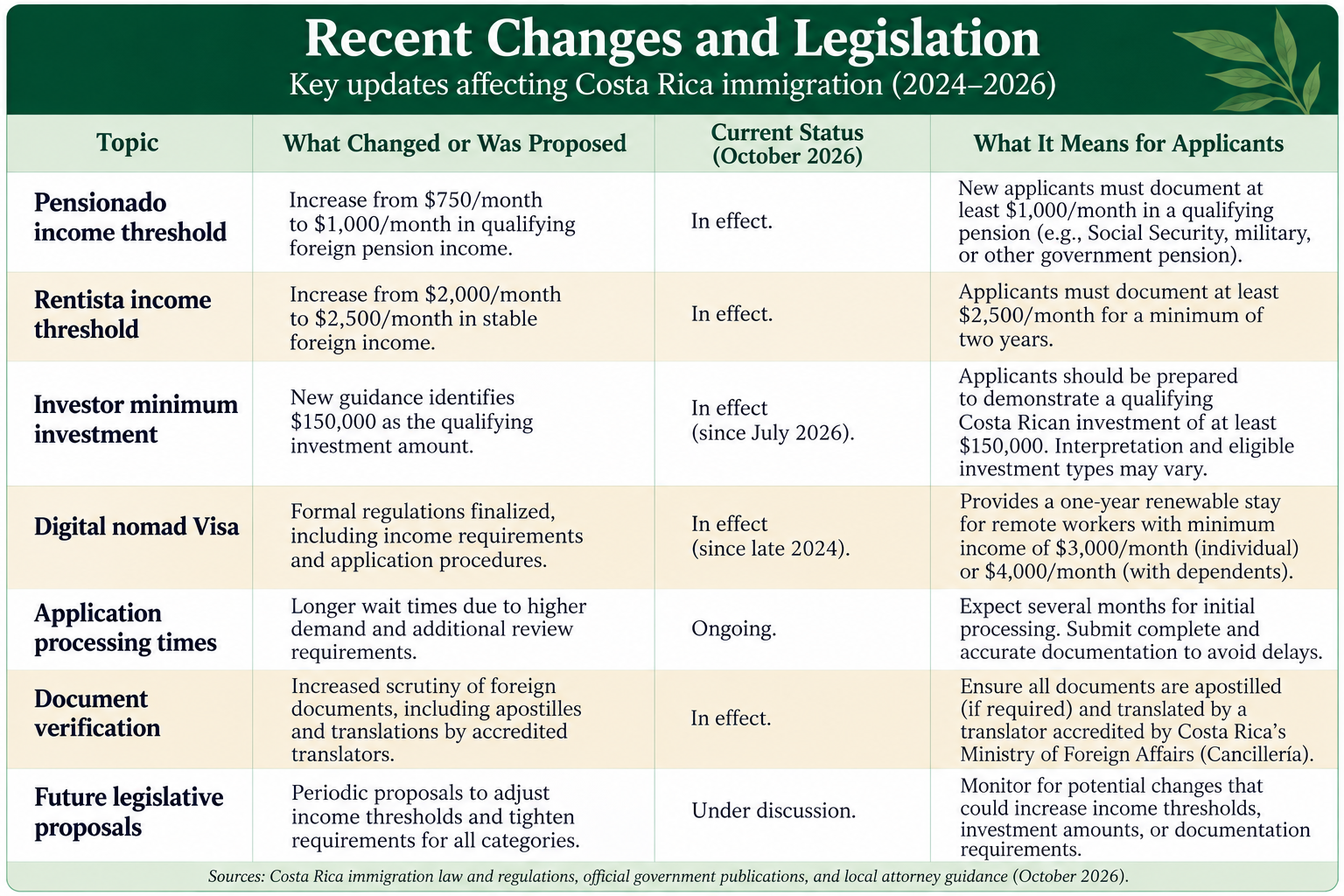
The proposed 90-day reentry restriction should therefore not be presented as current law. The digital nomad proposal should likewise be described as proposed legislation, with its final text and status checked again before publication. (sinalevi.go.cr, delfino.cr, sinalevi.go.cr, delfino.cr)
Planning for a lasting home at ESM
For families settling here, pensionado, rentista, or investor residence may offer a longer-term foundation. After three consecutive years of qualifying temporary residence, eligible applicants may apply for permanent residence. The change requires an application and approval. Tourist visits and digital nomad stays are not counted as part of those three years. (icoder.go.cr)
The practical starting point is a family-wide review: who qualifies as principal, who qualifies as a dependent, how the household earns its income, and whether anyone plans to work locally. Property ownership, business ownership, and immigration work authorization are separate questions. Temporary residents may undertake only the remunerated (paid) activities Immigration authorizes, so plans to teach, coach, consult, or to operate a business may need to be reviewed alongside the residency application. (icoder.go.cr)