
Rethinking Rental Fees at Ecovilla San Mateo
By Staff Writer Claudia
As Ecovilla San Mateo continues to grow, questions about how we share the costs of maintaining our community are becoming increasingly important. One emerging discussion concerns whether owners who rent their homes should contribute an additional percentage of their rental income to the Owners’ Assembly.
At first glance, the proposal seems straightforward. Rental properties bring additional people into the community, those guests use shared facilities, and the resulting wear and tear may create additional expenses. A rental fee could help offset those costs while generating revenue for future improvements.
But the question becomes more complicated when we consider who rents, why they rent, what owners already contribute, and how such a policy might influence the development of our village.
Perhaps most importantly, we should ask whether this is the right moment to introduce a new financial obligation into a community that is still in its earliest stages of becoming a residential village.
The Argument for Rental Fees
Those supporting rental fees raise legitimate concerns about fairness and the long-term sustainability of shared infrastructure.
Rental guests may use swimming pools, roads, trails, ranchos, parking areas, and other communal facilities. As rental activity increases, so might maintenance requirements, administrative responsibilities, and the costs associated with managing a larger population of temporary residents.
A fee based on rental revenue could provide a mechanism for owners operating income-producing properties to contribute beyond their regular condominium dues.
There is also an argument that rental activity introduces a commercial dimension into what is fundamentally a residential community. Owners who earn income from their properties may reasonably be expected to help support the environment that makes those properties attractive to visitors.
These are valid considerations, particularly as Ecovilla San Mateo approaches its eventual population of hundreds of households.
However, identifying a possible future expense is not the same as demonstrating that the expense currently exists.
The Other Side: Ownership, Fairness, and Economic Consequences
Every lot owner already contributes to the maintenance of shared infrastructure through regular condominium fees. Those obligations exist whether the owner lives at ESM full-time, visits occasionally, leaves a property vacant, or rents it to someone else.
An owner who rents a home does not necessarily create more community usage than an owner who occupies the same home with family and friends.
A family of four renting a casita for several weeks may use fewer communal resources than a larger owner-occupied household. Likewise, an owner who hosts extended family throughout the year may generate similar facility usage without triggering any rental-related charge.
This raises a fundamental question: Are we attempting to recover the actual costs of additional usage, or are we creating a fee simply because rental income exists?
The distinction matters.
A percentage-of-revenue fee is not necessarily proportional to community impact. A higher-priced rental does not automatically cause greater wear on roads or swimming pools than a lower-priced one.
There are also economic consequences. Rental owners generally account for taxes, utilities, cleaning, maintenance, furnishing, vacancy, and other expenses when setting rates. An additional fee becomes another cost that may ultimately be passed to renters.
At ESM, those renters may not be tourists at all. For the next several years, many prospective renters are likely to be fellow ESM owners visiting to oversee construction, meet contractors, or spend time in the community before their own homes are completed. In those circumstances, rental fees could effectively transfer additional costs from one neighbor to another.
One possible response would be to exempt rental fees for renters who are existing ESM owners. Yet this introduces further administrative questions: How would eligibility be verified? Would family members qualify? What about long-term guests or prospective owners?
A seemingly simple fee can quickly become a complicated regulatory system.
There is, however, a legitimate counterargument worth considering. Revenue collected through rental fees could help offset the rising costs of maintaining our common areas, potentially reducng the need for future increases in monthly condominium dues for all owners. As ESM expands its shared amenities, an additional revenue stream could help distribute these growing expenses more broadly. This is a meaningful potential benefit, particularly for owners who do not rent their properties.
Learning From La Ecovilla
La Ecovilla provides a useful example of an established community that has developed a differentiated rental-fee structure.
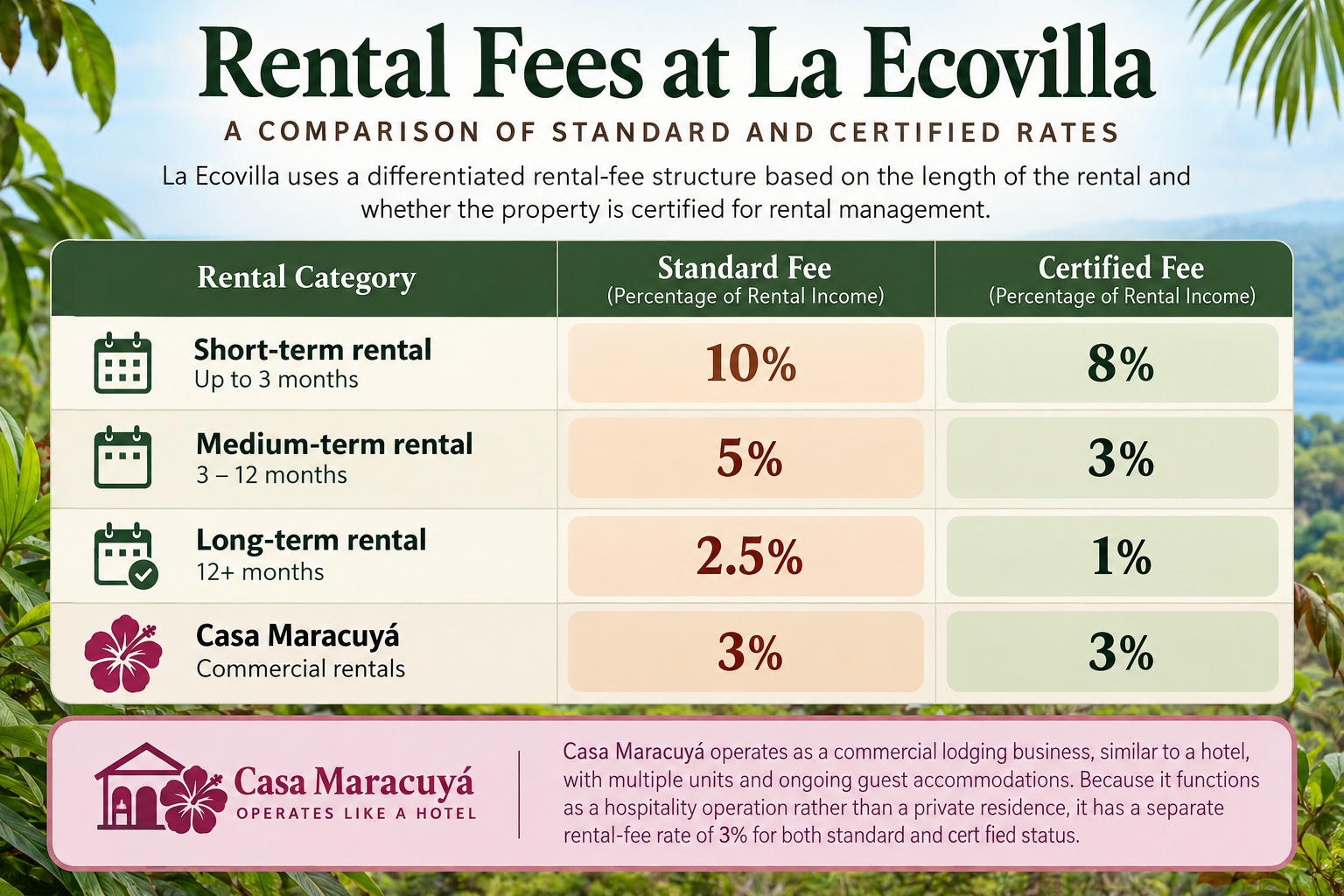
The structure recognizes that short-term and long-term rentals may affect the community differently. It also creates a financial incentive for owners to obtain certification for rental property management.
But the existence of a model elsewhere does not automatically mean it is appropriate for ESM today. La Ecovilla’s structure raises questions that would need to be resolved before considering a similar policy.
What qualifies an owner for certification? Who issues it? What operating standards must be met? Is there an application or renewal fee? Who verifies compliance, and what happens if certification is denied or revoked? These details matter because certification determines whether an owner pays a substantially different fee.
If ESM adopted a comparable system, the certification process itself would need to be clearly defined, legally reviewed, and incorporated into the proposal submitted to the Owners’ Assembly. It should not be left to future interpretation after a rental-fee policy has already been approved.
What Would These Fees Actually Mean?
Consider a casita rented for $125 per night for 15 nights in a month.
The gross rental revenue would be $1,875.
A 10% rental fee would amount to $187.50, while an 8% fee would be $150.
These charges would come in addition to existing condominium dues and the owner’s expenses associated with operating the rental.
For a modest rental property, the fee could represent a meaningful portion of the income remaining after operating costs.
For larger properties commanding significantly higher nightly rates, the financial impact could be considerably greater, even when the number of guests and their use of shared facilities are similar.
This illustrates why a percentage-based fee deserves careful economic examination rather than being treated as a simple maintenance contribution.
A Village Still in Its Infancy
Perhaps the strongest argument for caution is the current stage of Ecovilla San Mateo’s development. As of October 2026, approximately 10 families live here full-time. Even by the end of 2027, we anticipate fewer than 40 resident families across a development of more than 350 lots.
In other words, we are considering rules for a future community that has barely begun to take shape. Our current experiences may not accurately predict how rental activity, infrastructure demands, or shared-facility usage will evolve.
At present, many owners are still constructing homes, navigating the challenges of relocation, and determining how their properties will be used. Some will live here permanently. Others may visit seasonally, accommodate relatives, or rent their homes during extended absences.
These arrangements are not necessarily signs of commercial development. They are often part of the ordinary flexibility that makes international residential communities viable. Introducing significant rental fees now could influence these decisions before we understand their broader implications.
It could discourage owners from making homes available to neighbors, reduce accommodation options during construction, or increase the cost of spending time in ESM. It may also create a precedent that proves difficult to revisit once the community grows.
Rising 2027 HOA Fees?
Another important consideration is that our existing condominium fees are expected to increase in 2027 as Ecovilla San Mateo continues developing its shared spaces and infrastructure.
We currently have six common areas open, including swimming pools and ranchos that are already expensive to operate and maintain. As the community grows, additional expenses are anticipated, including planting and maintaining new gardens, expanding Wi-Fi coverage to more common areas, and continuing the upkeep of existing facilities.
These improvements benefit the entire community, but they also represent growing financial obligations for every lot owner, regardless of whether their property is occupied, vacant, or rented. And no, your 2026 monthly payments do not cover these future gardens and Wi-Fi locations
The Importance of the Owners’ Assembly
Any proposal to introduce rental fees must follow the condominium’s governing procedures and applicable legal requirements.
This is not simply a decision for the Board of Directors. A proposal requiring an amendment to the governing framework would need approval through the Owners’ Assembly, including the applicable two-thirds supermajority requirement.
The precise voting threshold, eligible voting interests, and treatment of abstentions or ineligible owners should be verified with legal counsel before the vote. That makes participation especially important.
Owners should understand not only the proposed percentages but also the full administrative structure, enforcement mechanisms, exemptions, and financial implications. A vote on rental fees should never leave fundamental questions about certification, exemptions, or implementation unanswered.
What Are Our Options?
Several reasonable approaches deserve consideration.
Adopt a rental-fee structure now. This would establish a revenue mechanism early, but would require detailed rules and administrative oversight before we have substantial evidence of rental-related costs.
Introduce lower or differentiated fees. A modest fee, perhaps varying by rental duration such as LEV’s, could reduce the financial burden while acknowledging potential differences between short-term and long-term occupancy.
Exempt rentals to ESM owners. This could protect owners who need temporary accommodation while their homes are under construction, although verification and eligibility rules would need to be established.
Create a certification framework. This might encourage responsible rental management, but it would introduce another administrative process requiring clear standards, oversight, and approval.
Defer rental-fee proposals for two to four years. This would allow the community to develop, observe actual rental patterns, measure infrastructure impacts, and determine whether additional charges are necessary.
Each approach has advantages and disadvantages. The central question is not whether rental fees can ever be justified, but whether we have sufficient evidence to justify them today.
Why Waiting May Be the Wisest Decision
Ecovilla San Mateo is not yet a mature residential community with established rental patterns, predictable visitor numbers, or a documented history of rental-related infrastructure expenses. We are still building the village itself.
A two-to-four-year pause would allow us to collect meaningful information rather than establish a permanent financial structure based largely on expectations.
During that period, the community could monitor rental occupancy, assess whether temporary residents actually create disproportionate costs, evaluate the adequacy of existing condominium dues, and develop clear standards for responsible property management.
It would also give owners time to understand their own needs and the ways in which their homes might contribute to community life. Waiting does not mean ignoring legitimate concerns. Existing rules governing safety, noise, facility usage, guest conduct, and residential activity can continue to apply equally to owners and renters.
If rental activity eventually produces measurable costs that cannot reasonably be covered through existing dues, the community would have a stronger factual basis for discussing additional contributions. And if those costs do not materialize, we may discover that a rental-specific fee was never necessary.
A Recommendation: Pause for Two to Four Years
My recommendation is that Ecovilla San Mateo postpone any proposal to introduce rental-income fees for at least two years, and preferably consider a review period extending up to four years.
With only approximately 10 full-time families today, fewer than 40 anticipated by the end of 2027, and more than 350 lots in the development, we simply do not yet have the residential population or operating history needed to evaluate the consequences of such a policy.
This is not an argument against responsible financial planning. It is an argument for making financial decisions based on demonstrated needs rather than anticipated problems. Our village has an opportunity to develop its governance gradually, guided by actual experience, transparent accounting, and the participation of its owners.
The freedom to use and enjoy our properties is an important part of why many of us chose Ecovilla San Mateo. So is our shared responsibility to protect the environment, infrastructure, and community we are creating. Those values need not be in conflict.
For now, perhaps the most responsible decision is to give our village time to grow before deciding what additional financial obligations its future residents should carry.
Sometimes good governance is not about introducing another rule. It is about recognizing when a decision can responsibly wait.