
The Machete: One Blade, a Hundred Jobs
Article and art by Staff Writer Ryan
Step outside almost anywhere in San Mateo and within a few minutes you'll spot one — hanging from a belt loop, leaning by a gate, catching sunlight mid-swing through roadside grass. The machete isn't a specialty tool here. It's closer to a house key: something almost everyone carries without thinking twice about it, and something almost nobody remembers acquiring. It just arrives, usually as a gift, early into life here.
A Tool Older Than the Country
Long-bladed cutting tools go back to prehistory, when sharpened stone or metal served the same all-purpose role the machete does now. Nearly every region with dense vegetation grew its own version of the idea — the African panga, the Filipino bolo, and, across Latin America, the machete.
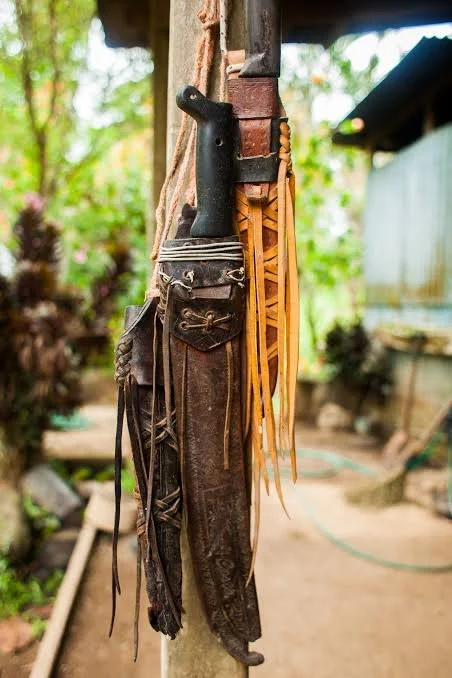
The name itself is telling: it comes from the diminutive of the Spanish macho, meaning strong. Elsewhere in the region the blade has historically doubled as a weapon, but in Costa Rica its job today is squarely agricultural. As the outlet El Colectivo 506 puts it, "the machete's sole purpose is to keep the ever-growing farm and forest at bay." It's the one implement that outlasted every wave of imported machinery, because nothing else does that job as cheaply or as quietly.
Why It Never Went Out of Style
The honest answer is that the jungle doesn't take days off. Writer Vincent Losasso described the machete in the Tico Times as "a weedwhacker, a chainsaw and a lawnmower all in one" — one tool, no gas, no charging, no repair shop, always ready. In a climate where a cleared path can be swallowed by growth in under two weeks, that reliability beats any powered alternative.
It's also deeply cultural. Giving someone a machete is a classic welcome-to-the-campo gesture; Losasso's own father-in-law handed him one as his introduction to Tico life, no explanation needed. And the skill locals bring to it is real — a well-kept edge turns a swing through brush into one clean metallic TING, a sound that takes real practice, and real patience with a sharpening stone, to earn.
Choosing the Right Blade
Not every machete suits every job, which is why you'll see such variety on a single finca. Shorter blades, 12 to 18 inches, give more control for close pruning; the 24- to 26-inch range is the workhorse length for clearing grass and light brush, long enough to cover ground yet manageable for a full day's work.
Shape matters too: a straight, wide blade favors chopping through woody stems, while a curved or hook-tipped blade slices better through grass and vines. Farm supply shops often stock blades named for specific crops — cane-cutting, corn-cutting — evidence of a tool refined, generation over generation, down to exactly what each job needs. Carbon steel holds an edge beautifully and is easiest to re-sharpen by hand, which is why most working blades are made of it; stainless needs less babying but still earns its keep in a coastal or rainy-season environment.
What It Replaces on a Finca
If you're maintaining any finca, garden, or overgrown quebrada bank, a machete earns its keep fast. It trims grass, clears trail, prunes, harvests bananas, opens coconuts, and cuts back brush that reclaims a path the moment you stop weeding it. One well-chosen blade replaces a shed full of powered equipment and needs nothing more than an occasional pass with a file to stay ready.
Keeping the Edge
Moisture is the blade's real enemy, so dry it after any wet work — rain or wet vegetation — before it goes back in the sheath. Oil it regularly, especially carbon steel; a light coat of non-detergent or 3-in-1 oil is enough. Clear sap and debris after each use, since trapped plant matter holds moisture against the steel and speeds up corrosion, and keep the handle dry too — a damp wood or leather handle can wick moisture onto the blade from the inside.
Don't store it sheathed long-term; a sheath traps condensation, so if it has to live in one, oil the interior and check it now and then. Sharpen often at a consistent angle, little and frequent rather than occasional and aggressive. And use it — a machete left idle in a corner rusts faster than one in regular rotation.
Handling One With Respect
A machete deserves the same caution as any loaded tool. Keep it sheathed except when actively cutting, and clear a roughly 10-foot radius of people, pets, and low branches before you start — and say so if someone's nearby.
Use a relaxed pinch grip, thumb and first two fingers, rather than a tight fist; it's more comfortable over a long session and, counterintuitively, more controlled. Gloves and a wrist lanyard help too, especially if your hands sweat. Swing to the side, never across your body, at roughly a 45-degree angle rather than straight down, which cuts more efficiently and tires your arm less. For thick material, alternate angled strikes to open a V-notch rather than forcing one blow through.
Stop to move rather than walking while swinging, and quit before fatigue sets in — most accidents happen once form slips late in a session, not at the start. A sharp blade is a safer blade, too: dull edges force harder, less controlled swings to do the same work.
A Tool Worth Passing On
Ask around for a few weeks and you'll likely find a neighbor who learned their sharpening technique from a parent or grandparent, or a longtime Tico friend who can turn a dull blade razor-sharp in a few unhurried minutes with nothing but a hand file. That know-how comes from someone showing someone else, the way it's been passed along here for generations — probably still the best first step for anyone new to the machete life.
Pura vida, and swing safely out there.